Sign in to edit
Anyone can edit Apple Dance — you just need an account so your work can be credited and an editor knows who to ask if there's a question. It takes one click with Discord.
Editing Apple Dance
Changes go to an editor for review before they appear. Nothing here is published directly.
Loading the current page…
Origin: a week after the album
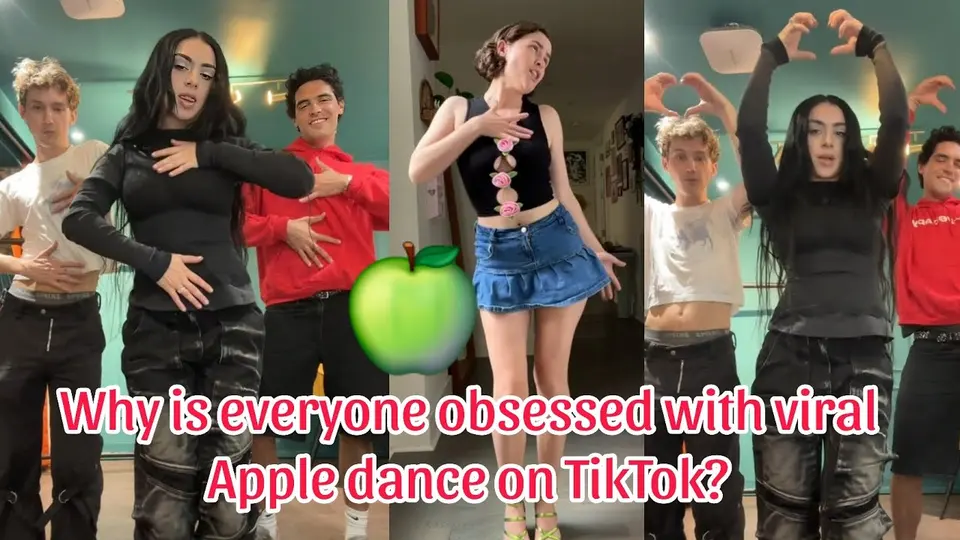
Charli XCX released Brat on June 7, 2024. One week later, on June 14, 2024, New York TikTok user and aspiring choreographer Kelley Heyer (@kelley.heyer) posted a routine set to the album track “Apple.” She reposted a cleaned-up version on June 15, and that take — roughly 1.3 million views in its first month — became the canonical one.
The choreography is mostly arms, hands and face: a mimed apple pick, a steering-wheel turn, a shrug, all landing on the lyric about the apple being rotten right to the core. It is designed for a phone camera, performable sitting down, and it maps the words almost literally, which makes it unusually easy to learn from a single viewing.
The artist joined in
The trend’s tipping point came fast. On June 28, 2024 — two weeks after Heyer’s post — Charli XCX performed the dance herself, a clip that took over 10 million views in roughly two weeks. Artist adoption is the single strongest accelerant a dance trend can get, and it converted the routine from fan content into part of the Brat live experience.
Variants stacked up through July 2024 at an unusual clip:
- A cat-themed version on July 3 — 6.9 million views in two weeks.
- A version by an Amish TikToker on July 11 — 6.5 million views in five days.
- Actor Kevin Chamberlin’s take on July 14 — 5.7 million views in two days.
The dance then travelled to festival crowds, where thousands of people performing it simultaneously during “Apple” became one of the defining images of the Brat touring era, including at Coachella in 2025.
The ownership fight
Here is what makes the Apple dance historically interesting rather than just popular. Heyer treated her choreography as licensable property, and largely made it stick:
- She reportedly licensed the dance to Fortnite, where it was used in a December 2024 in-game event, and to Netflix.
- In April 2025 she sued Roblox, alleging the platform sold her routine as a purchasable emote — used in the game Dress to Impress — after licensing negotiations broke down without an agreement.
- The suit was later reported as amicably resolved in court filings.
That sequence matters because the previous decade of viral dances was defined by the opposite outcome: creators, disproportionately young Black choreographers, watching their routines get monetised by everyone but them. The Renegade credit fight in 2020 forced the argument into public view. The Apple dance is one of the first cases where a choreographer set terms up front, got paid by two major platforms, and litigated the one that did not pay.
Why it caught
“Apple” was never released as a lead single, which meant the dance did the promotional work an official campaign usually does. The routine also fit Brat’s aesthetic exactly — deliberately lo-fi, unfussy, obviously homemade — so the fan version and the artist version looked like the same thing.
It remains the reference point for 2024’s pop-culture summer, and for the argument that a viral dance is a piece of authored work with an owner attached.
Opens “Apple Dance” in the generator, ready to caption.
Examples & gallery
Frequently asked
Who created the Apple dance?
Kelley Heyer, a New York TikTok user and choreographer, who posted the first version on June 14, 2024 and a revised take the following day. The routine is set to 'Apple' from Charli XCX's album Brat, released June 7, 2024, and its second version gathered around 1.3 million views in a month.
Did Charli XCX do the Apple dance herself?
Yes, on June 28, 2024, roughly two weeks after the original was posted. The clip took over 10 million views in about two weeks and turned the routine into part of the Brat live show, with festival crowds performing it en masse during the song throughout the tour that followed.
Why did the Apple dance creator sue Roblox?
Heyer alleged Roblox sold her choreography as a purchasable emote, used in the game Dress to Impress, after licensing talks ended without a deal. She had already licensed the routine to Fortnite and Netflix. The lawsuit, filed in April 2025, was later reported in court filings as amicably resolved.
Why does the Apple dance matter beyond TikTok?
It is one of the first viral dances whose creator successfully treated the choreography as licensable property, securing deals with major platforms and taking legal action over unauthorised use. That reverses the pattern set by earlier trends, where choreographers frequently went uncredited and unpaid while platforms and brands profited.
Sources
Embed this meme
Paste this anywhere. It shows the card and credits the entry underneath.
Related memes

What links here
One page links to Apple Dance.
- Wednesday Dance related entry
Discussion
Corrections and context welcome. Editors read this thread.
Sign in to join the discussion.
No comments yet.