Sign in to edit
Anyone can edit Demotivational Posters — you just need an account so your work can be credited and an editor knows who to ask if there's a question. It takes one click with Discord.
Editing Demotivational Posters
Changes go to an editor for review before they appear. Nothing here is published directly.
Loading the current page…
Origin
The target came first. Successories, founded by Mac Anderson in 1985, built a business selling framed motivational prints for offices and boardrooms: a sweeping landscape or a rowing crew, a single word in capitals — TEAMWORK, PERSEVERANCE, EXCELLENCE — and a short aspirational sentence beneath it. By the 1990s the format was ubiquitous enough in corporate America to be instantly recognisable, and instantly mockable.
In 1998, Despair, Inc., founded by Dr. E.L. Kersten, began selling “Demotivators” — prints that copied the layout exactly and inverted the message. Same black frame, same thin white keyline, same reverent photograph, same bold capitalised word. Only the sentiment changed, from encouragement to bleak corporate realism. The company leaned into the bit thoroughly, and in 2000 obtained a US trademark on the frowning emoticon :-( for use on greeting cards, posters and art prints. A 2004 CNN report put the company at around $4 million in annual sales, and the New York Times profiled Kersten in April 2008.
Going user-made
The format was trivially reproducible, and the internet reproduced it. Amateur versions were circulating on fan forums by September 1, 2004, when a “Harry Potter Demotivational Posters” thread appeared on the Chamber of Secrets board. TechRepublic ran a “Demotivators strike again” gallery on July 18, 2006.
Free generator sites did the rest. Drop in an image, type a bold word and a smaller line beneath, and the site produced a finished poster in seconds — the same click-and-publish model that made Advice Dog macros explode a few years later. Imgflip and similar tools still host demotivational makers today.
Anatomy of the format
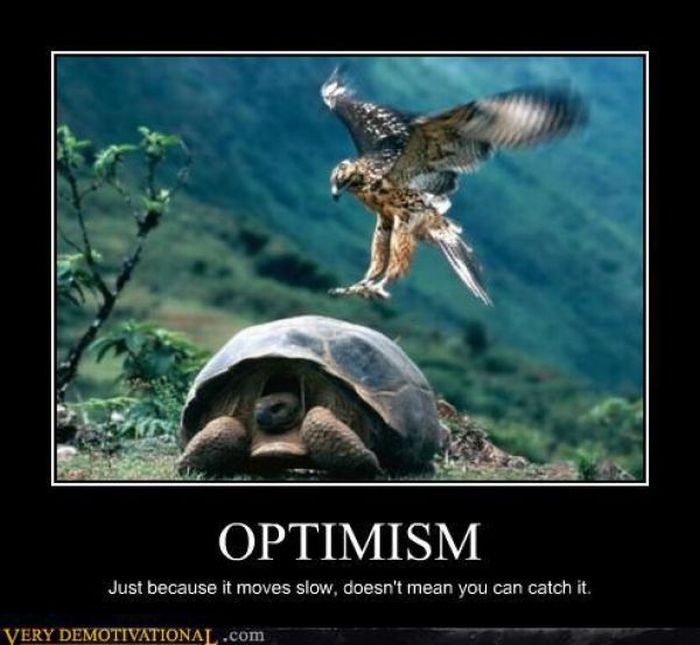
The layout does the comedy, which is why it survived so long:
- A black field with a thin white border around the image, imitating a mounted print.
- A large word in serif capitals, spaced widely, presented as a virtue.
- A smaller line beneath that undercuts, contradicts or bleakly explains it.
Everything about it looks earnest. The joke is entirely in the gap between the presentation and the content, which is why demotivators work best when read straight — the more solemnly the poster is framed, the harder the punchline lands.
Usage and range
The format is used to mock, deflate or deliver a dark-comedy punchline in deadpan corporate register. Its range is wide: gentle jokes about work and hobbies at one end, genuinely bleak or surreal entries at the other, plus enormous numbers of fandom-specific versions built from film and game screenshots. Because the caption slot accepts anything, entire communities generated their own local canons of posters that made sense only to members.
Legacy
Demotivational posters were a workhorse of mid-2000s forum humour — everywhere on message boards, image boards and early Facebook, and one of the first templates ordinary users could produce without image-editing skills. They also established a structure that outlived them: a big word plus a small subtitle, the label-and-undercut pattern visible in later formats from X, X Everywhere to One Does Not Simply.
The style now reads as strongly period-specific, which has given it a second life as deliberate retro pastiche — posted, like O RLY? or an early lolcat, partly for the joke and partly for the era it summons.
Opens “Demotivational Posters” in the generator, ready to caption.
Examples & gallery
Frequently asked
What is a demotivational poster?
It is a parody of a corporate motivational poster. It copies the same black-framed layout, reverent photograph and bold capitalised word, but replaces the inspiring subtitle with something sarcastic, cynical, bleak or absurd. The straight-faced presentation is what makes the joke work.
Where did demotivational posters come from?
They parody the motivational prints sold by Successories, founded by Mac Anderson in 1985. In 1998 Despair, Inc., founded by Dr. E.L. Kersten, began selling commercial parodies called Demotivators, and free online generators spread the user-made version through the mid-2000s.
Who is Despair, Inc.?
A satirical company founded in 1998 by Dr. E.L. Kersten that sells Demotivators, the commercial parodies of motivational posters. CNN reported around $4 million in annual sales in 2004, and in 2000 the company obtained a US trademark on the frowning :-( emoticon for cards, posters and art prints.
Are demotivational posters still made?
They are, though mostly as deliberate retro pastiche. Generator tools such as imgflip still offer demotivational makers, but the format's peak was mid-2000s forum and image-board culture, and the style now reads as strongly period-specific. Its 'big word plus subtitle' structure went on to influence many later caption formats.
Sources
Embed this meme
Paste this anywhere. It shows the card and credits the entry underneath.
Related memes




What links here
One page links to Demotivational Posters.
- Honey Badgermentioned in
Discussion
Corrections and context welcome. Editors read this thread.
Sign in to join the discussion.
No comments yet.