Sign in to edit
Anyone can edit Excited Katie Bouman — you just need an account so your work can be credited and an editor knows who to ask if there's a question. It takes one click with Discord.
Editing Excited Katie Bouman
Changes go to an editor for review before they appear. Nothing here is published directly.
Loading the current page…
Origin
On April 10, 2019, the Event Horizon Telescope collaboration released the first image ever made of a black hole — the supermassive object at the centre of the galaxy M87, resolved by combining data from radio telescopes across the planet into a single Earth-sized virtual instrument.
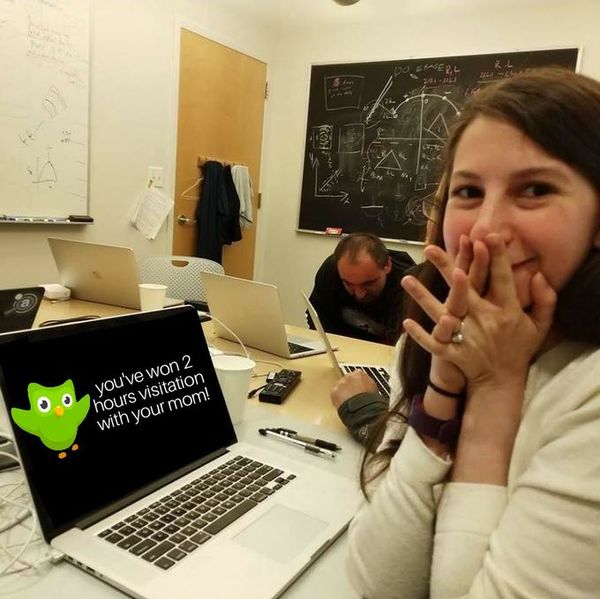
The photograph that accompanied the announcement online was not of the black hole. It was of Dr. Katie Bouman, a computer scientist then at MIT, sitting at a laptop with both hands pressed over her mouth, watching the image render for the first time.
Bouman had led development of an imaging algorithm — CHIRP — that was one of several methods used to reconstruct a picture from the telescope array’s sparse data. The photograph captured the moment that work resolved into something visible.
What it means / how it’s used
The image became a wholesome symbol of scientific joy — shorthand for the moment years of abstract work becomes a result you can see.
It is used for:
- Genuine excitement at an achievement.
- The moment something finally works.
- Celebrating research, engineering, or any long project paying off.
- Sincere posts about women in science and engineering.
Its appeal is that the reaction is completely unguarded. There is no performance in it; she is simply overwhelmed.
What happened next
The story around the photograph is a significant part of its history, and it went badly in two directions at once.
Some coverage framed Bouman as the sole author of the image — a “lone genius” narrative that was inaccurate. The result came from a collaboration of roughly 200 researchers, and Bouman said so publicly and repeatedly, consistently redirecting credit to the team.
A backlash then formed on the premise that she had claimed credit she never claimed. She was subjected to sustained online harassment, including coordinated attempts to reassign her contributions to a male colleague. That colleague, Andrew Chael, publicly rejected the framing, called the attacks sexist, and pointed out that the work being credited to him was itself the product of the wider team. Press reporting at the time noted the harassment was severe enough that Bouman had to shut off her phone.
Both the over-crediting and the backlash misrepresented what she had actually said.
Notable examples & variations
- The original photograph, shared sincerely.
- Side-by-side versions pairing her reaction with the black hole image.
- Uses in science-education and outreach contexts.
- Posts marking the anniversary of the image’s release.
- Later images of her with the 2022 Sagittarius A* result.
Legacy / cultural impact
The photograph remains one of the most widely recognised images of a scientist at work, and it is regularly cited in discussions of how science is communicated. The episode is a standard case study in the media’s preference for single-protagonist narratives over collaborative ones — and in what that preference costs the person placed at the centre.
Bouman continued her research, becoming a faculty member at Caltech, and has consistently used the attention to make the same point she made in 2019: the picture was taken by two hundred people.
Opens “Excited Katie Bouman” in the generator, ready to caption.
Examples & gallery
Frequently asked
Who is Katie Bouman?
A computer scientist who led development of the CHIRP imaging algorithm, one of several methods used to reconstruct the first image of a black hole. She was at MIT at the time and later joined the Caltech faculty.
What is the photo?
Her reaction, hands over her mouth, as the first black hole image rendered. It was released alongside the Event Horizon Telescope announcement on April 10, 2019.
Did she create the image by herself?
No, and she never claimed to. The result came from a collaboration of roughly 200 researchers, and she repeatedly redirected credit to the team.
What was the controversy?
Some coverage wrongly framed her as the sole author, and a backlash then harassed her for a claim she had not made. Her colleague Andrew Chael publicly rejected attempts to reassign her work to him and called the attacks sexist.
Sources
Embed this meme
Paste this anywhere. It shows the card and credits the entry underneath.
Related memes





What links here
One page links to Excited Katie Bouman.
- First Image of a Black Holerelated entry
Discussion
Corrections and context welcome. Editors read this thread.
Sign in to join the discussion.
No comments yet.