Sign in to edit
Anyone can edit Planking — you just need an account so your work can be credited and an editor knows who to ask if there's a question. It takes one click with Discord.
Editing Planking
Changes go to an editor for review before they appear. Nothing here is published directly.
Loading the current page…
Origin: the Lying Down Game
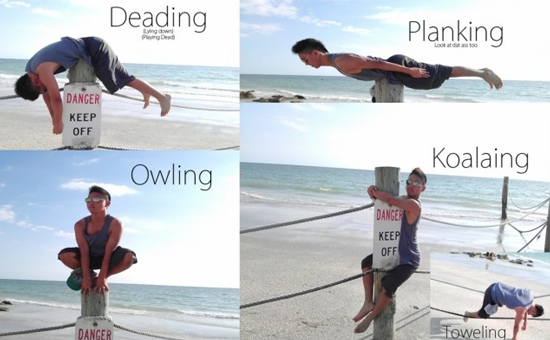
Planking is a participatory photo fad: a person lies face-down, rigid, arms flat at their sides like a wooden plank, in an unexpected or public place, and the photo gets posted.
Its direct ancestor is the Lying Down Game, which two teenagers — Gary Clarkson and Christian Langdon — reportedly invented in Taunton, Somerset, England, in 1997, describing it later as a deliberately stupid, random thing to do. It stayed a local joke for a decade until a Facebook page appeared in 2007, framing it as a competition to capture the strangest photo. Antecedents exist further back and elsewhere — Wikipedia documents a version played by American high-schoolers in the mid-1980s and a South Korean “playing dead” fad around 2003 — but the Facebook page is what made it transmissible.
The name changed in Australia. “Planking” was reportedly coined around 2008, variously credited to a group in Adelaide who set up a fan page for it and to a New Zealander living in Sydney. Regional names proliferated in parallel: extreme lying down, facedowns.
The game first drew serious press in September 2009, when seven accident-and-emergency staff at Great Western Hospital in Swindon, England were suspended after posting photos of themselves lying face-down on hospital equipment during a night shift, with management citing health-and-safety and infection-control rules.
The 2011 explosion
Australia turned it into a global craze. On March 27, 2011, Manly-Warringah Sea Eagles winger David “Wolfman” Williams planked after scoring a try against the Newcastle Knights, then discussed it on radio and television. The gag went national overnight — the main Facebook page reportedly gained more than 130,000 fans within a week — and then international.
Milestones came fast:
- May 13, 2011 — a journalist declared May 25 the “First Annual Global Planking Day.”
- Mid-2011 — celebrities including Katy Perry, Justin Bieber, Demi Moore and Rosario Dawson were photographed planking.
- September 2, 2011 — NBA player Dwight Howard planked with roughly 100 fans in Beijing as part of an Adidas promotion.
- September 19, 2011 — a bill filed in the Philippine House of Representatives sought to outlaw the stunt.
The craze also produced genuine alarm. On May 15, 2011 a 20-year-old man in Brisbane died after falling from a seventh-floor balcony while attempting a plank, and Australian police and officials issued public warnings against dangerous locations. Coverage after that point ran heavily on safety rather than novelty, and several countries saw participants charged over trespassing or public-nuisance offences.
Why it worked
Planking was one of the first mass “do it yourself and post it” crazes of the social-media era, and its mechanics explain the speed. The rules were trivially simple, the equipment was a body and a camera phone, and the result was legible in a single frame with no caption. The humour came entirely from juxtaposition — a rigid, deadpan pose against an ordinary or dramatic setting — which meant escalation was built in: each participant had to find a stranger location than the last.
Successors
Planking set the template for a decade of participatory fads, and its immediate imitators arrived within months:
- Owling — squatting like an owl, first documented on Reddit on July 11, 2011.
- Horsemaning — a two-person pose faking a decapitation, revived from an old photo trick.
- Batmanning — hanging upside down by the feet.
- Teapotting — reportedly started by teachers attempting to manufacture a trend.
- Dufnering (2013) — slouching against a wall, named after golfer Jason Dufner.
Legacy
None of the successors matched the original’s reach, and the wider form moved on to challenges with a charitable or musical hook — the Ice Bucket Challenge, the Harlem Shake, the Mannequin Challenge. Planking is now remembered as the defining participatory meme of the early 2010s, and as an early demonstration that a craze with no barrier to entry can outrun anyone’s ability to moderate it. The word itself has largely reverted to its other meaning: the abdominal exercise.
Opens “Planking” in the generator, ready to caption.
Examples & gallery
Frequently asked
What is planking?
It is a photo fad in which a person lies face-down, body rigid and arms flat at their sides like a wooden plank, in an unusual or public place, then posts the picture. The humour is entirely in the juxtaposition of the deadpan pose against an unexpected setting, and it needs no caption to work.
When was planking popular?
It peaked as a global craze in 2011, having grown out of the earlier Lying Down Game reportedly started in Taunton, England in 1997. The Australian surge began on March 27, 2011 when NRL player David "Wolfman" Williams planked after scoring a try, and it spread worldwide within weeks.
Where did the name "planking" come from?
The word was reportedly coined in Australia around 2008, credited variously to a group in Adelaide who set up a fan page and to a New Zealander living in Sydney. Before that the same stunt circulated under other names, including the Lying Down Game in Britain and extreme lying down in Australasia.
What came after planking?
A wave of imitator photo fads, most of them short-lived: owling, first documented on Reddit in July 2011, along with horsemaning, batmanning, teapotting and, in 2013, Dufnering. None matched planking's reach, and the participatory format later shifted toward video challenges like the Ice Bucket Challenge and the Mannequin Challenge.
Sources
Embed this meme
Paste this anywhere. It shows the card and credits the entry underneath.
Related memes






What links here
3 pages link to Planking.
- Grandma Finds the Internetrelated entry
- Gentleminionsmentioned in
- The Dabmentioned in
Discussion
Corrections and context welcome. Editors read this thread.
Sign in to join the discussion.
No comments yet.