Sign in to edit
Anyone can edit Oh My God, They Were Roommates — you just need an account so your work can be credited and an editor knows who to ask if there's a question. It takes one click with Discord.
Editing Oh My God, They Were Roommates
Changes go to an editor for review before they appear. Nothing here is published directly.
Loading the current page…
Origin: one overheard sentence on Vine
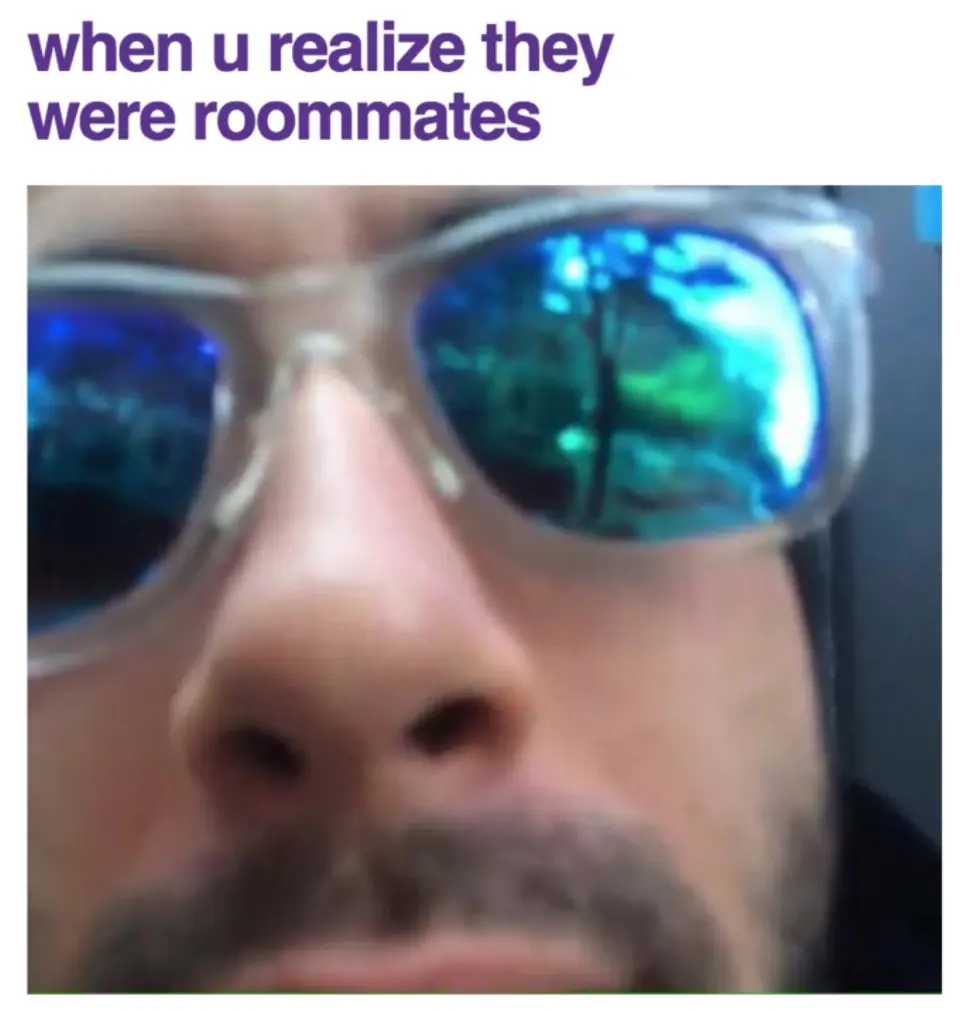
On October 25, 2014, Vine user @mattsukkar posted a clip filmed while walking behind a woman on her phone. The camera catches exactly one fragment of her conversation — “…and they were roommates!” — before he spins the phone around to his own face and repeats it back in a scandalised whisper: “Oh my god, they were roommates.”
That is the whole video. Six seconds, no setup, no punchline beyond the delivery. The Vine collected over 380,000 likes, 188,000 revines and more than 60 million loops, and an embedded copy on Tumblr picked up over 807,000 notes — numbers that put it in the top tier of the platform’s overheard-stranger genre alongside Road Work Ahead and Why You Always Lying.
Why the delivery works
The joke is entirely in the gap between what was said and how it was received. The woman on the phone is telling a mundane story. @mattsukkar hears it as a bombshell — the tone of someone who has just been handed the last piece of a conspiracy. Nothing in the clip explains what would be so shocking about two people sharing a flat, and the meme’s whole afterlife is built on filling in that blank.
Vine’s format helped: with six seconds and no room for context, the platform rewarded clips that were pure reaction, and this one is arguably the purest example of the form.
Tumblr and the historians’ euphemism
The line found its permanent home on Tumblr, where it collided with a long-running joke about the way close same-sex relationships get described in textbooks, museum placards and biographies — as “companions,” “lifelong friends,” or, yes, roommates.
The format became collaborative and two-part, exactly the kind of thing Tumblr’s reblog chain was built for:
- One user posts a genuine or invented historical detail ending in “…and they lived together for forty years.”
- Another reblogs it with a single line: “oh my god, they were roommates.”
Individual chains ran to 143,000 and 111,000 notes. Fandom adopted the same construction for shipping — applying it to characters whose subtext readers found rather louder than the text — and the phrase became a compact way to say the historical record is being coy and we all know it.
Where it sits now
The Vine outlived its platform. When Vine shut down in January 2017, the clip survived in compilation videos, YouTube reuploads and as a TikTok audio, and it is still deployed in three distinct registers:
- Genuine historical commentary, usually about figures whose relationships were documented in deliberately vague language.
- Fandom shipping shorthand, applied to any two characters who share a flat, a bunk or a safehouse.
- Straight literal use, as a reply to any story that involves actual roommates, purely for the bit.
It is also a small monument to Vine’s real legacy. The platform’s best-remembered clips were rarely produced — they were found: a stranger’s sentence, a phone flipped around, and a delivery good enough that a million people would repeat it a decade later.
Opens “Oh My God, They Were Roommates” in the generator, ready to caption.
Examples & gallery
Frequently asked
Where does 'oh my god, they were roommates' come from?
A Vine posted by @mattsukkar on October 25, 2014. He filmed a woman walking ahead of him on the phone, caught the fragment 'and they were roommates,' then turned the camera on himself and gasped the line back. The clip earned more than 60 million loops before Vine shut down.
What does the phrase mean?
It is used to point out that two people described as merely friends or flatmates were very likely a couple. The joke targets the euphemistic language of textbooks, museum labels and biographies, and by extension any story where the obvious romantic reading is being carefully avoided by the narrator.
Why is it so associated with Tumblr?
Because Tumblr's reblog chain made the two-part structure work: one user posts a detail about two people who shared a home for decades, and the next replies with the line. Individual chains ran past 140,000 notes, and fandom shipping communities adopted the same construction for characters with unacknowledged subtext.
Is the original Vine still online?
Vine itself shut down in January 2017, but the clip survives in reuploads, compilations and as a reusable audio on TikTok and Instagram. Because the joke is carried entirely by the audio and the delivery, it transfers cleanly to sound-based platforms without needing the original video at all.
Sources
Embed this meme
Paste this anywhere. It shows the card and credits the entry underneath.
Related memes






Discussion
Corrections and context welcome. Editors read this thread.
Sign in to join the discussion.
No comments yet.