Sign in to edit
Anyone can edit Hampster Dance — you just need an account so your work can be credited and an editor knows who to ask if there's a question. It takes one click with Discord.
Editing Hampster Dance
Changes go to an editor for review before they appear. Nothing here is published directly.
Loading the current page…
Origin: a bet about web traffic
The Hampster Dance was built in August 1998 by Deidre LaCarte, a Canadian art student, and hosted for free on GeoCities. Its reason for existing was a friendly contest: LaCarte, her sister and a friend were competing to see whose page could pull the most traffic. Hers was an homage to her pet hamster, Hampton, and was originally titled Hampton’s Hamster House, with a note declaring Hampton’s intention to become a web star.
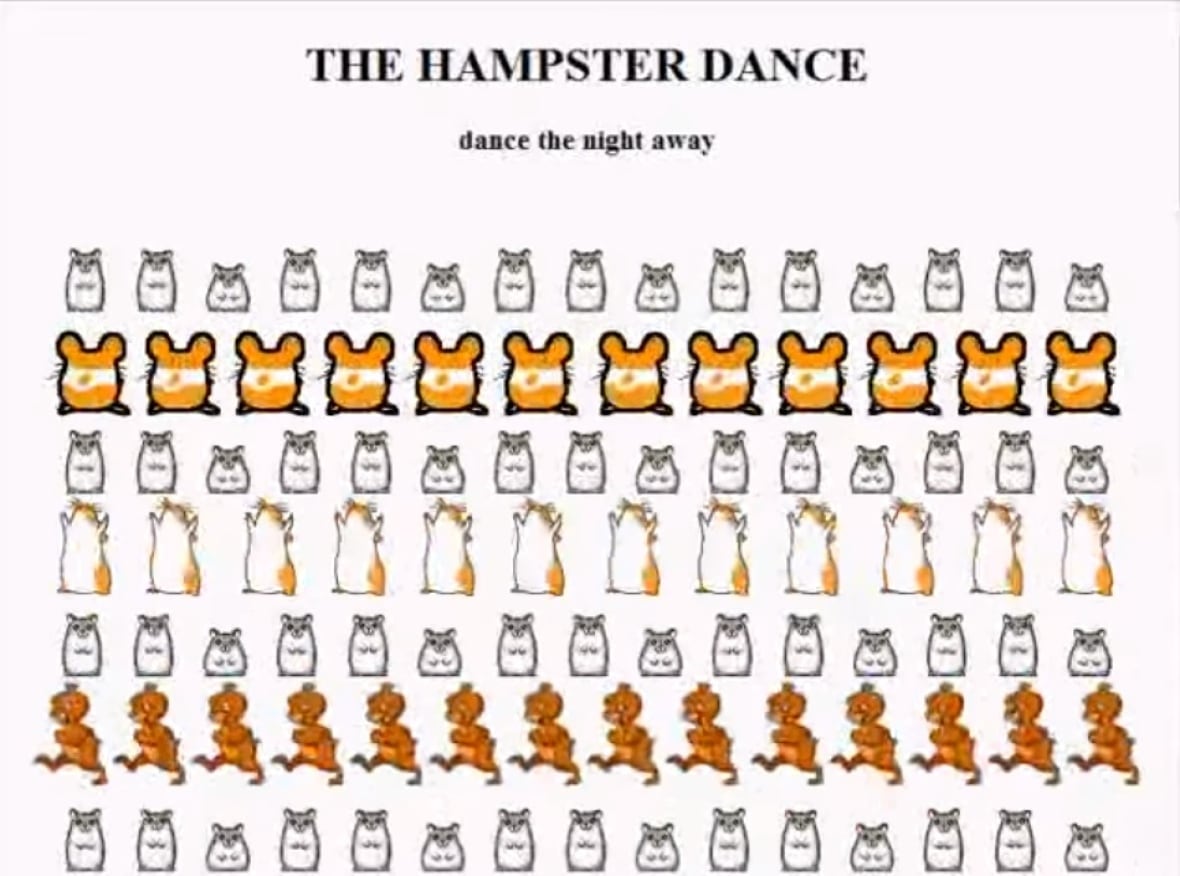
The page itself was almost nothing: rows of looping animated GIF rodents — commonly cited as 392 sprites — dancing in a handful of different styles against a plain background, with a high-pitched song looping underneath. The misspelling of “hamster” as “hampster” was never corrected, and became part of the identity.
The song
The audio is a sped-up, pitch-shifted loop of “Whistle Stop,” the whistled Roger Miller tune from Disney’s 1973 Robin Hood. Slowed back to normal speed it is instantly recognizable; at Hampster Dance speed it becomes a chirping novelty loop with no obvious source, which is a large part of why the page felt like a found object rather than a reference.
How it spread
Nothing about the site was promoted. It travelled by email forwards, early blogs and link-swapping — plus bait-and-switch pranks, where the URL was passed off as something else entirely. Traffic reportedly sat at a few hundred hits a day for roughly eight months before word of mouth reached critical mass and it climbed to around 15,000 hits a day during 1999.
That pattern — a single silly page, spread person to person with no platform, no algorithm and no advertising — is why it is routinely named as one of the first viral websites and one of the earliest internet memes, alongside the Dancing Baby and Badger Badger Badger.
The novelty single
The loop was re-recorded and released as a standalone single, “The Hampsterdance Song,” credited to Hampton the Hampster, in 2000. It was a genuine chart record rather than a curiosity: it reportedly topped the Canadian singles chart and reached the top five in Australia, and an album followed. Merchandise, plush toys, spin-off sites and a small industry of imitators trailed behind it.
The commercial afterlife made the Hampster Dance one of the first demonstrations that a free web novelty could be converted into a product — a lesson the next twenty-five years of internet culture would repeat constantly.
Legacy
- The grid-of-dancing-GIFs layout became a reusable joke format, endlessly parodied and revived.
- The song remains shorthand for the late-1990s web in documentaries, nostalgia compilations and retro-web art projects.
- CBC Arts later published an oral history of the site, treating it as a genuine cultural artifact rather than a gag.
- It is a fixed reference point for the “single-serving site” — one page, one joke, no navigation — a form that ran through Peanut Butter Jelly Time, All Your Base Are Belong to Us and eventually the whole Rickroll bait-and-switch tradition.
What the Hampster Dance proves is how little a meme needs. There was no character, no punchline and no story — just a tiled GIF and four seconds of sped-up Disney whistling, forwarded by people who wanted someone else to see it.
Opens “Hampster Dance” in the generator, ready to caption.
Examples & gallery
Frequently asked
Who made the Hampster Dance and when?
Canadian art student Deidre LaCarte built it on GeoCities in August 1998, as part of a friendly competition with her sister and a friend over who could attract the most web traffic. She named it after her pet hamster, Hampton. It went genuinely viral about eight months later, during 1999, spreading almost entirely by email.
Why is it spelled 'Hampster' Dance?
The creator used the misspelling when naming the page and it was never corrected. Because the URL and the page title both carried it, the error propagated with every link and forward, and 'hampster' became the meme's permanent spelling — a small piece of the era's charm rather than a mistake anyone tried to fix.
What is the Hampster Dance song?
It is a sped-up, pitch-shifted loop of 'Whistle Stop,' the whistled Roger Miller theme from Disney's 1973 animated Robin Hood. At normal speed the source is obvious; sped up, it sounds like an anonymous novelty jingle, which is why most listeners never connected it to the film.
Did the Hampster Dance song chart?
Yes. Re-recorded and released as 'The Hampsterdance Song' credited to Hampton the Hampster in 2000, it reportedly reached number one on the Canadian singles chart and the top five in Australia, followed by an album and merchandise. It was one of the first cases of a free web novelty being turned into a commercial product.
Sources
Embed this meme
Paste this anywhere. It shows the card and credits the entry underneath.
Related memes






What links here
7 pages link to Hampster Dance.
- Dancing Babyrelated entry
- Leekspin (Loituma Girl)related entry
- YTMND (You're the Man Now, Dog)related entry
- All Your Base Are Belong to Usmentioned in
- Badger Badger Badgermentioned in
- Caramelldansenmentioned in
- Peanut Butter Jelly Timementioned in
Discussion
Corrections and context welcome. Editors read this thread.
Sign in to join the discussion.
No comments yet.